People & Culture
Why Portugal’s Pavements Are Black and White
Small stones, cut and fitted by hand, form the waves at Rossio and geometric patterns across Portuguese streets and squares.
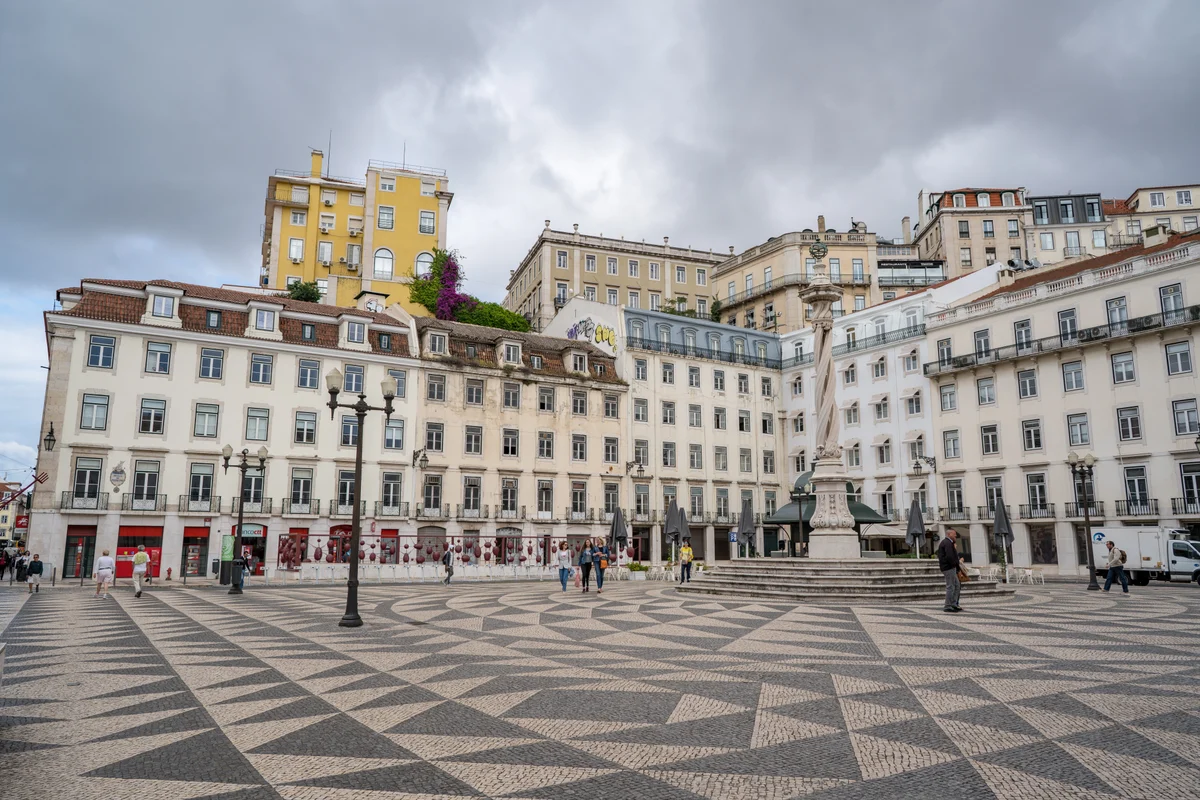
Calçada portuguesa is paving made from small stones cut and fitted by hand. Contrasting colours let its makers draw waves, borders and pictures across a public square. White and black are familiar, but the stone and the palette vary by region.
Where did this form of paving begin?
The modern decorative tradition took shape in Lisbon in the 1840s. In 1842, military engineer Eusébio Pinheiro Furtado had prisoners lay a black-and-white pavement at São Jorge Castle. The labour was coerced. The national heritage inventory describes the prisoners’ ankle chains.
The success of that experiment led to the larger Rossio scheme, completed in 1849. Portugal had stone paving long before this date, so 1842 marks a development in decorative practice rather than the invention of paved streets.
Is the black stone always basalt?
No. Much of Lisbon’s present-day black-and-white paving uses limestone in both colours. Dark limestone is not the same rock as basalt, which is volcanic. The early castle design is described as limestone and basalt.
Local stone gives the paving regional differences. Basalt is prominent in the Azores and Madeira, granite occurs in the north, and Alentejo examples include marble and schist.
Explore three pavement designs
No matching entries.
-
Mar Largo waves
Rossio, Lisboa
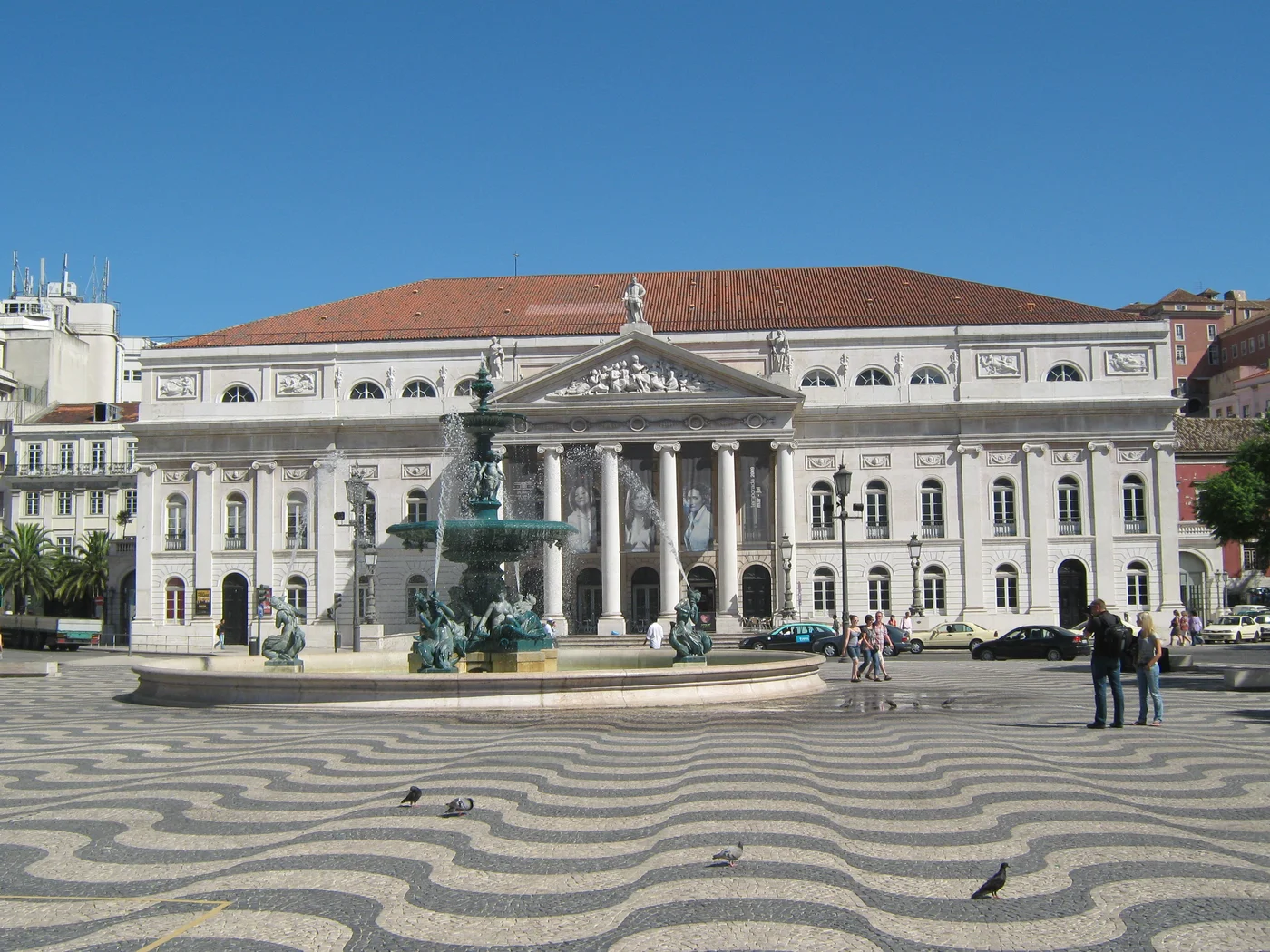
Rossio on 1 July 2009. The alternating bands make the flat ground appear to rise and fall. Pedro Ribeiro · CC BY 2.0 Mar Largo means open sea. The wave design was laid at Rossio in 1849 to commemorate Portuguese maritime expansion. It has since been reconstructed.
- Material
- Contrasting light and dark natural stone.
-
Eduardo Nery’s geometry
Praça do Município, Lisboa
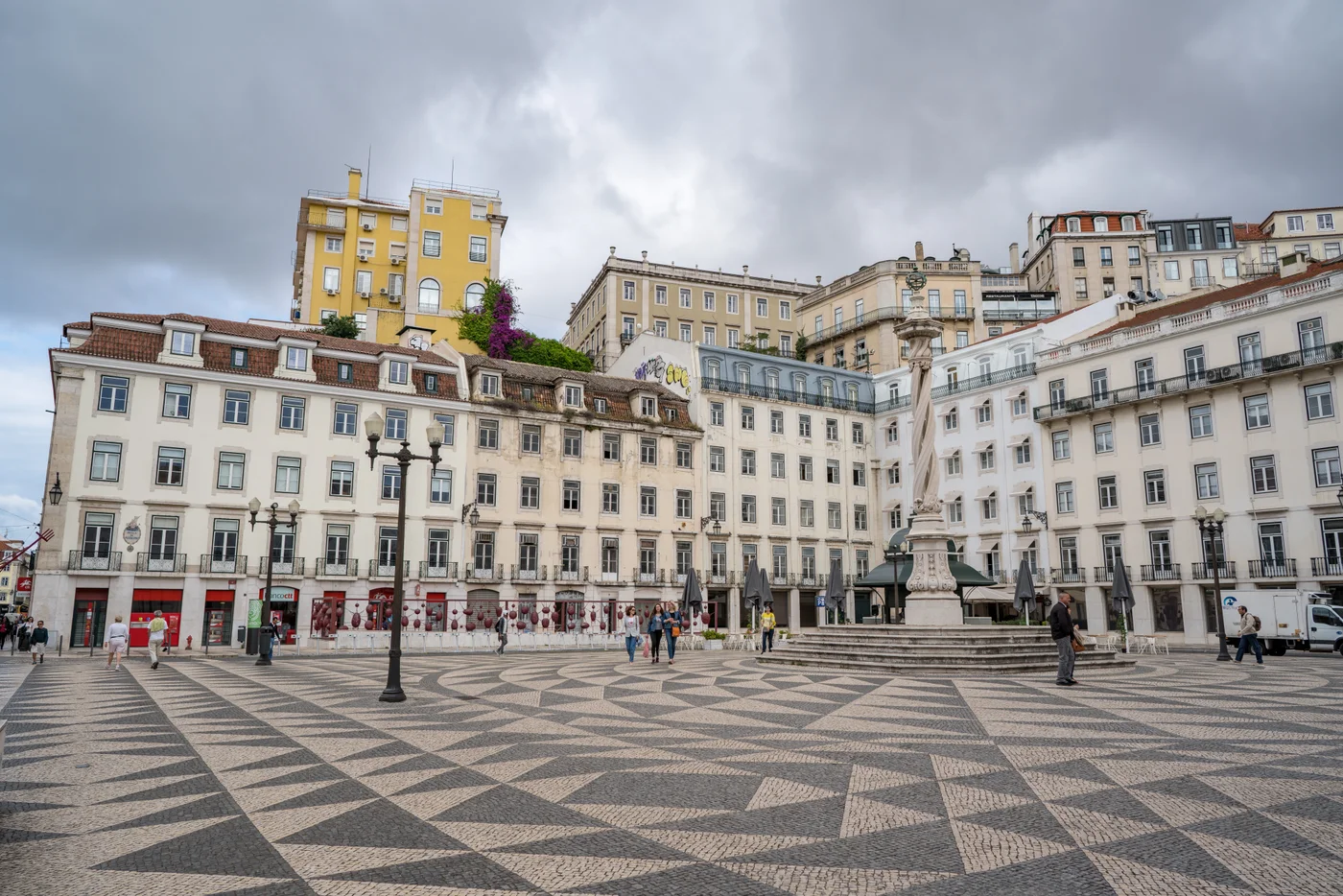
Praça do Município on 28 May 2018. Nery’s geometry covers the pedestrian area around the pillory. Nan Palmero · CC BY 2.0 Eduardo Nery designed this geometric pavement for the 1997–1998 resurfacing of Praça do Município. Repeated triangles and squares create a pattern that can be read through reflection and rotation.
- Material
- Hand-cut light and dark stone cubes.
-
Avenue borders and foliage
Avenida da Liberdade, Lisboa
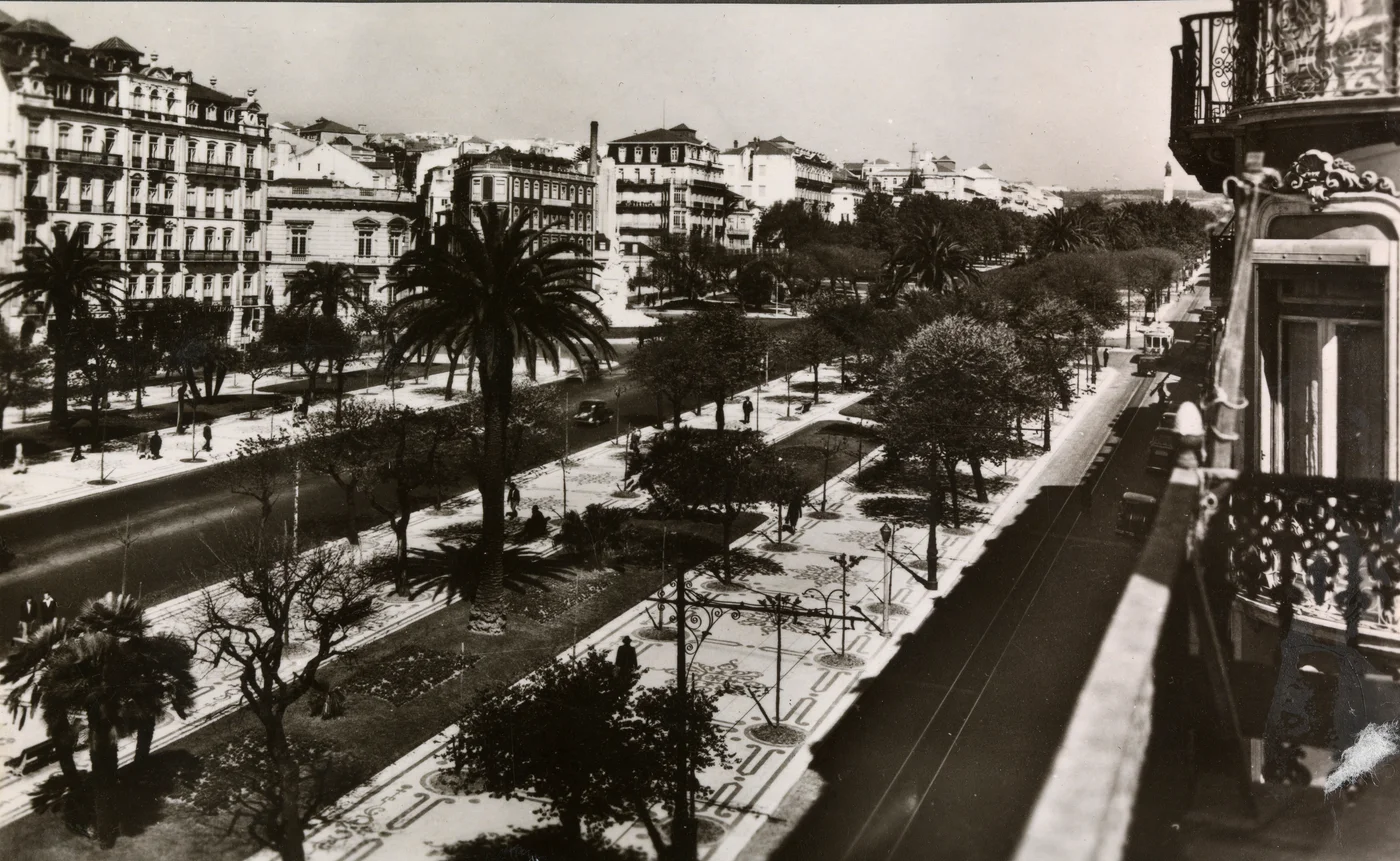
Avenida da Liberdade on 28 April 1951, photographed from a balcony. The paving combines rectangular borders with curving motifs. ETH-Bibliothek Zürich, Bildarchiv · CC BY-SA 4.0 This archival view shows foliage motifs and repeating borders on Avenida da Liberdade in 1951. The avenue is part of Lisbon’s official Portuguese-pavement route.
- Material
- Small natural-stone mosaic paving.
How does a calceteiro make the pattern?
A calceteiro is a craft worker who cuts and lays paving stones. The worker chooses the upper face, trims the edges with a paving hammer and taps the stone into its sand bed. Neighbouring pieces must fit closely enough to hold one another in place.
Large designs can use templates, but the fit still depends on the person handling each stone. A square-cut infill and an irregular polygonal malhete pattern require different cuts. Lisbon’s municipal school has taught the craft since 1986.
Why is the workforce a concern?
On 16 January 2026, the Portuguese government put the average age of paving workers at 55 to 60. It reported only 22 formal professional certifications between 2021 and 2024. In about half of municipalities, every member of the paving team was over 50.
The figures point to a shortage of younger entrants, especially in municipal teams. The government announced a working group on skills and training, while Lisbon’s paving school continues to teach new workers. The certification total counts formal qualifications, not everyone practising the trade.
Has UNESCO inscribed it?
As of 19 September 2026, the craft has a UNESCO candidacy, but no UNESCO inscription. Its 2021 entry in Portugal’s national inventory, with urgent safeguarding needs, is a separate recognition.
Parliament’s Resolution 55/2026, published on 24 March, made 22 July the national day of the paving worker and Portuguese pavement. It also recommended training support and further work on the UNESCO nomination.
Can preservation and accessible streets coexist?
A pavement is also a route to a bus stop, a shop or someone’s front door. Loose stones and uneven joints can obstruct wheels or catch a foot. Polished surfaces need particular attention when wet.
Portugal’s accessibility rules require pedestrian surfaces to be stable, firm and continuous, with slip resistance where water is expected. Those requirements concern the finished surface and its maintenance. Lisbon’s Almirante Reis consultation records competing requests to retain calçada and to improve walking conditions.
Join the conversation
Add your Note
Sign in or create a free account to respond. Reading the conversation remains open to everyone.